01
Justice
Wrongdoing should be examined fairly, with responsibility and accountability at the centre of the process.

God's Court of the People is being developed as an independent international court founded on justice, peace, truth, human dignity and accountability.
The Court is currently in its founding stage. The proposed Founding Treaty is being made available for review, discussion and the beginning of a secure digital signing and ratification process.
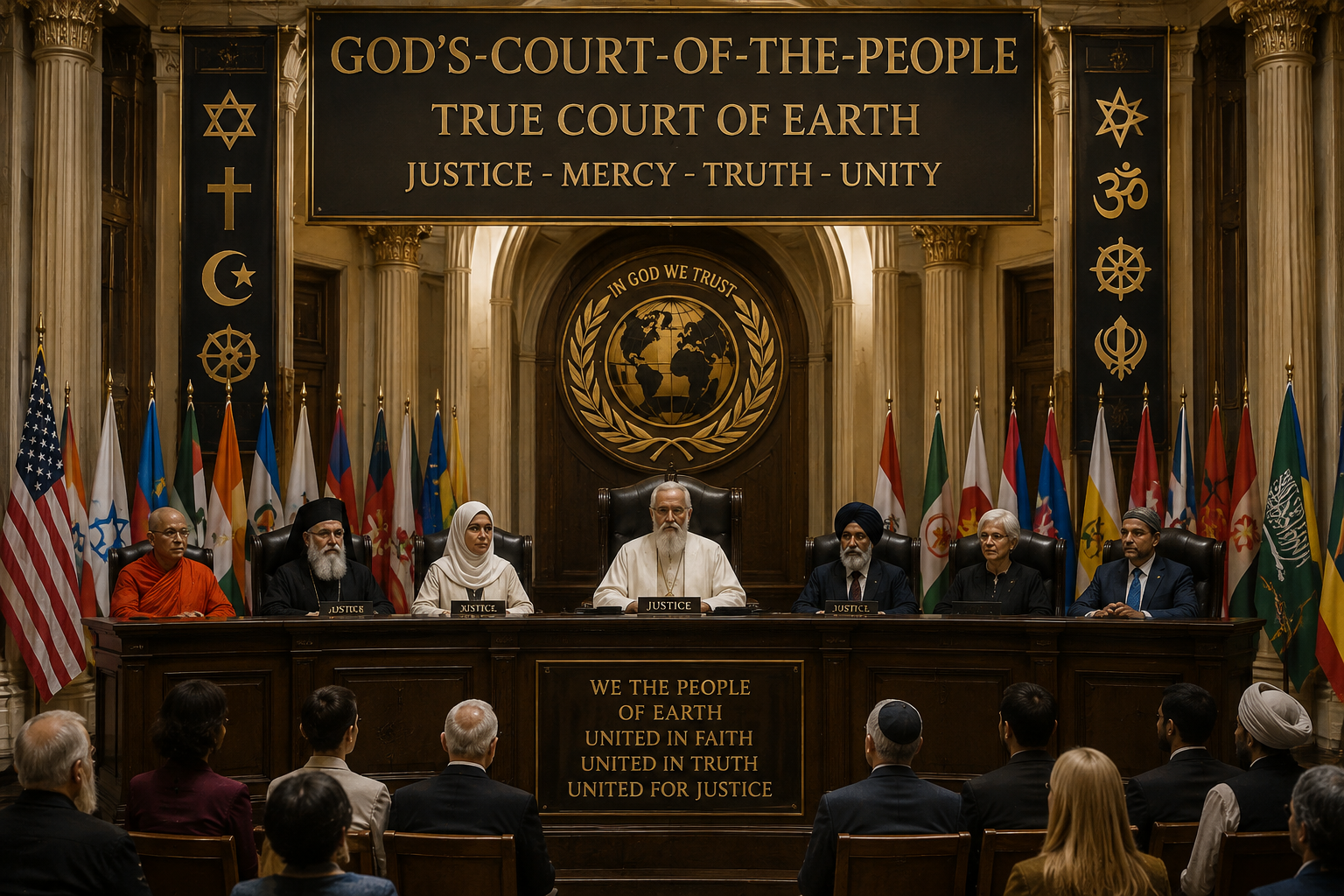
Wrongdoing should be examined fairly, with responsibility and accountability at the centre of the process.
Justice should recognise human dignity and leave room for compassion, proportionality and restoration where appropriate.
Evidence, honesty and careful examination should guide decisions rather than fear, prejudice or concealed interests.
The Court's vision is for people of different nations, cultures and faiths to be heard and treated with equal dignity.
God's Court of the People recognises the distinction between divine judgment and human law. Matters concerning the soul, salvation and ultimate judgment belong solely to God. The Court exercises no divine or spiritual jurisdiction and determines only those legal matters properly placed within its jurisdiction.
The Proposed Founding Treaty is available for public review together with the Court Rules that implement its procedures. The Treaty currently contains 57 numbered Articles and a Final Declaration. Eligible States, nations, constituent countries, territories, autonomous communities and other qualifying political communities can express interest and submit a proposed signing/ratification record for review without needing to travel.
The digital process records an expression of interest or proposed signing/ratification submission for review. The Treaty is not yet legally established and no online submission by itself brings it into force.
The Treaty provides that a university degree is not the sole way to demonstrate competence where knowledge and skills can be objectively assessed. Written and oral examinations, practical legal problems, Treaty interpretation and ethical judgment can form part of the competency process.
View the International Law Examination →Article 52 recognises that sovereign States, nations, constituent countries, territories, autonomous communities and other qualifying political communities may have distinct identities and, where the Treaty requirements are met, may establish a separate relationship with the Court. A State's refusal to join does not by itself prevent a qualifying community from applying.
Explore the participation process →A matter or founding submission is presented with the relevant information and supporting material.
The matter, authority and evidence are reviewed before any hearing or determination is considered.
Parties and evidence can be considered through an organised and documented hearing process.
A decision can be recorded together with the reasoning and relevant court record.
The proposed Court can operate through secure video, including authorised participation from homes, police stations and other approved locations. Physical proceedings would use an appropriate existing host court until a dedicated Court facility exists.
View the proposed hearing system →Future public cases can have recorded hearings, verdicts, sentencing and authorised judgments preserved in a dedicated archive.
View Case Archive →Members of the public can express interest in proposed Court roles and complete a role-specific competency assessment.
Apply to serve →Judges, prosecutors, investigators, enforcement officers and other proposed personnel have separate tests covering knowledge, ethics and practical judgment.
The public-facing founding tools are being built alongside the Court's legal and administrative framework.
The Court, the independent Prosecutor's Office and the Academy operate through separate secure entry points. Court administration handles Court records and operations; the Prosecutor's Office handles its independent prosecutorial work; Academy administration handles educational records, assignments and marking.